


Small-space design challenges require targeted solutions that maximize functionality without sacrificing aesthetic appeal.
Japandi design principles offer an elegant approach to space optimization, combining Scandinavian efficiency with Japanese minimalism.
These methodologies address common limitations through precise furniture selection, intelligent storage integration, and careful material selection.
The following ten solutions demonstrate how thoughtful space planning can transform compact environments into serene, highly functional living spaces that respond to both practical needs and wellness considerations.
Embrace Multi-Functional Furniture for Maximum Efficiency

When space limitations demand smart design choices, multi-functional furniture emerges as the cornerstone of Japandi-inspired small-space optimization.
Fold-out beds and extendable dining tables exemplify space-saving solutions that maintain the minimalist aesthetic while maximizing compact design efficiency.
Storage ottomans and nesting tables provide versatile solutions that eliminate clutter through integrated compartmentalization. Platform beds with built-in drawers optimize vertical space utilization without sacrificing clean-lined styling.
Modular furniture systems enhance flexibility, allowing configurations to be easily rearranged for different functional requirements.
This practical functionality approach guarantees that every piece serves multiple purposes while preserving Japandi’s serene design principles.
DIY storage ottomans with concealed compartments offer an accessible way to create extra seating while maintaining the clean aesthetic through foam padding and lightweight plywood construction.
Implement Custom Storage Solutions to Reduce Clutter
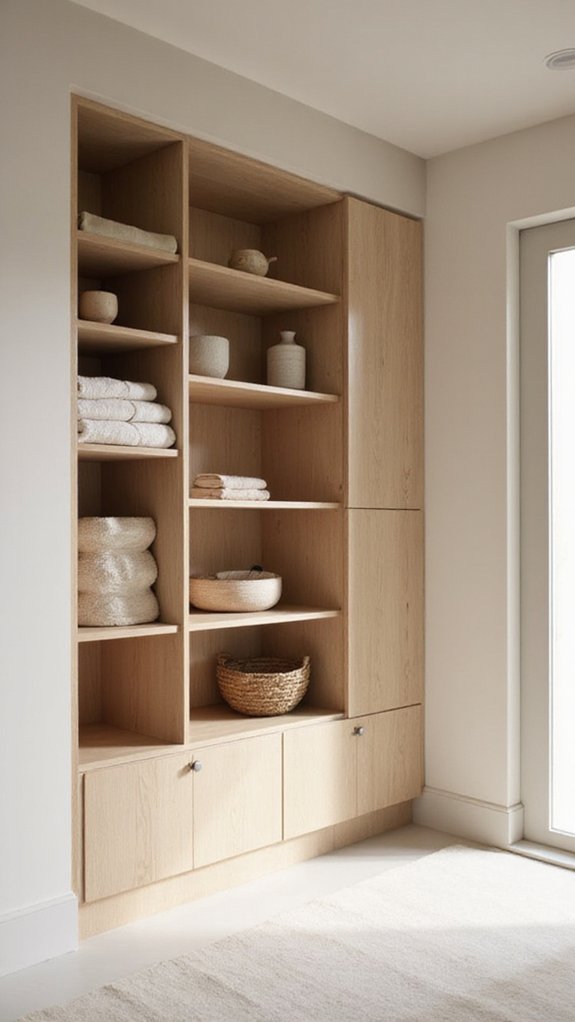
Building upon the foundation of versatile furniture pieces, custom storage solutions represent the next evolution in small-space optimization, where precision-engineered compartments eliminate visual chaos while preserving flow.
Precision-engineered storage compartments transform chaotic small spaces into flowing, visually harmonious environments through thoughtful design integration.
Targeted clutter reduction through minimalist storage transforms confined areas into serene environments. Built-in cabinets constructed from light wood materials maintain visual continuity while maximizing functionality.
Essential Custom Storage Applications:
- Wall-mounted drawers – Exploit vertical real estate without compromising floor circulation patterns
- Hidden compartments – Conceal belongings within multi-purpose furniture to sustain clean sightlines
- Under-bed storage systems – Utilize dead space beneath sleeping platforms for seasonal items
These space-saving solutions organize efficiently while preserving Japandi’s essential minimalist aesthetic through tailored design integration.
Floating shelves with clean lines can accommodate decorative containers while maintaining the serene visual harmony essential to Japanese-inspired design principles.
Use Light Color Palettes to Enhance Spatial Perception

Light color palettes function as optical amplifiers in small-space environments, where targeted deployment of whites, warm beiges, and soft greys maximizes natural light reflection to create expansive visual boundaries.
Neutral tones eliminate visual fragmentation across walls, furniture, and architectural elements, establishing unified planes that enhance dimensional perception.
Light-colored flooring systems, including large-format ceramic tiles, contribute to visual expansion through continuous surface reflection.
Soft hues in textiles prevent sensory overload while maintaining dimensional clarity.
Coordinated ambient lighting layers amplify brightening effects, creating luminous atmospheres that psychologically expand compact footprints.
These chromatically unified environments produce serene interiors with enhanced volumetric presence through scientifically proven light-reflection principles.
Matte and eggshell finishes amplify luminosity and diffuse light evenly across surfaces, maximizing the spatial-enhancement benefits of light color palettes in compact living environments.
Install Sliding Doors and Partitions for Flexible Layouts

Traditional Shoji-style sliding doors provide ideal space division in compact Japandi interiors by eliminating swing clearance requirements that consume valuable square footage.
These translucent partitions maintain visual continuity while creating functional zones, allowing natural light penetration throughout interconnected spaces.
The linear tracking system enables seamless reconfiguration between open-plan layouts and private compartments, maximizing utility within constrained floor plans.
Strategic placement of sliding partitions creates visual hierarchy and enhances the minimalist aesthetic while maintaining proportional balance between functional elements and architectural features.
Shoji-Style Space Division
Space-conscious homeowners seeking flexible interior configurations can implement shoji-style sliding partitions to achieve dynamic room division without compromising square footage efficiency.
These traditional Japanese design elements feature wooden frames with translucent materials, enabling natural light penetration while maintaining privacy.
Modern adaptations use frosted glass or textured panels, preserving the minimalist aesthetic essential to compact homes.
Key Implementation Strategies:
- Material Selection: Choose natural materials like bamboo frames with rice paper or modern frosted glass panels
- Room Zoning: Install sliding partitions to create multipurpose areas that adapt to daily activities
- Space Optimization: Eliminate swing clearance requirements, maximizing usable floor area in confined layouts
Shoji doors seamlessly integrate functionality with serene room awareness. Similar to open-backed cabinets used in loft-style designs, these translucent partitions maintain spatial flow while creating visual boundaries between functional zones.
Maximizing Flow and Function
Building upon partition-based room division, thoughtful installation of sliding doors and adaptable partitions transforms compact Japandi interiors into fluid, multi-functional environments.
These space-saving solutions eliminate swing clearance requirements while maintaining open flow throughout the dwelling.
Natural materials like wood and paper enhance the minimalist aesthetic while providing practical room division capabilities.
| Design Element | Functional Benefit |
|---|---|
| Shoji-style panels | Creates adaptable layout zones |
| Fluted glass partitions | Maintains visual connectivity |
| Lightweight wood frames | Enables easy room reconfiguration |
| Multi-track systems | Supports multifunctional space usage |
| Floor-to-ceiling installation | Maximizes compact design efficiency |
Thoughtful placement defines living zones without compromising continuity. Incorporating natural textures through wood grain patterns and organic materials creates tactile warmth that complements the clean lines of sliding partition systems.
Choose Moisture-Resistant Materials for Singapore’s Climate

Singapore’s relentless humidity and tropical climate demand thoughtful material selection to preserve the clean lines and natural textures fundamental to Japandi design.
Moisture-resistant materials prevent warping, decay, and structural compromise while maintaining aesthetic integrity.
Essential humidity-resistant selections include:
- Primary surfaces: Engineered wood and teak offer superior moisture tolerance while delivering authentic wood grain patterns.
- Furniture elements: Rattan and bamboo provide natural breathability and inherent moisture resistance for seating and storage solutions.
- Flooring systems: Ceramic tiles, laminate flooring, and wood-look vinyl deliver durability without sacrificing visual warmth.
These materials guarantee longevity while supporting Japandi’s minimalist philosophy, creating serene interiors that withstand Singapore’s challenging environmental conditions.
For wooden display elements and frames, systematic restoration techniques using moisture-resistant stains and protective topcoats ensure structural integrity in humid conditions.
Maximize Natural Light With Strategic Window Treatments

Thoughtful window treatment selection fundamentally transforms small-space light distribution while maintaining the minimalist aesthetic central to Japandi design principles.
Sheer fabric applications enable controlled daylight penetration without compromising visual privacy, creating ideal illumination conditions for compact residential environments.
Light-reflecting material integration amplifies natural luminosity through tactical placement and surface selection, maximizing area perception within confined square footage parameters.
Strategic positioning of LED solar lights with adjustable brightness settings can supplement natural illumination during evening hours while maintaining energy efficiency in small-space environments.
Sheer Fabric Window Solutions
Natural light serves as the foundation of authentic Japandi design, and sheer fabric window treatments emerge as the most effective solution for maximizing luminosity while preserving the aesthetic’s inherent minimalism.
These lightweight fabrics optimize small-space functionality through thoughtful design principles:
- Light diffusion optimization – Semi-transparent linen or cotton materials soften harsh sunlight, creating warm ambient lighting throughout Japandi interiors.
- Enhanced airflow circulation – Breathable textile construction promotes natural ventilation, vital for Singapore’s humid climate conditions.
- Layering flexibility system – Sheer panels integrate seamlessly with blinds or opaque curtains, enabling precise privacy control.
Unlined construction prevents visual heaviness, maintaining clutter-free environments while establishing the serene atmosphere essential to authentic minimalist design principles.
Natural fibers like linen and cotton provide organic textures that align perfectly with Japandi’s emphasis on sustainable materials and tactile authenticity.
Light-Reflecting Material Choices
While sheer fabrics establish the foundation for ideal light transmission, the thoughtful selection of light-reflecting materials amplifies natural illumination throughout compact Japandi environments.
Large-format light-colored tiles create reflecting surfaces that bounce daylight deeper into interiors, enhancing room perception while maintaining the airy atmosphere essential to minimalist design.
Carefully positioned mirrors opposite windows multiply natural light distribution, effectively doubling illumination sources.
Minimal window coverings featuring neutral finishes reduce visual weight while maximizing light diffusion.
Window treatments using bamboo or paper elements provide gentle light filtration without compromising brightness, ensuring optimal luminosity throughout small-scale spaces.
Incorporating hanging planters with light-reflecting materials like UV-resistant synthetic polymers maintains dimensional stability while complementing the clean lines and natural textures fundamental to Japandi aesthetics.
Create Defined Zones Without Compromising Flow

Open floor plans demand careful consideration of hierarchy to achieve functional separation without sacrificing the visual continuity essential to Japandi design principles.
Thoughtful furniture placement creates natural space delineation through low-profile pieces that maintain visual openness while establishing distinct zones.
Effective zoning techniques include:
- Transparent materials like fluted glass panels and open shelving that define areas without blocking sightlines
- Flooring differentiation through subtle material changes or area rugs that create boundaries while preserving flow
- Lighting variations using targeted fixtures to highlight individual zones without disrupting light and flow
Minimal dividers complement this approach, ensuring seamless progressions between functional areas. Outdoor rugs can similarly define functional areas in exterior spaces while maintaining the clean, uncluttered aesthetic fundamental to Japandi philosophy.
Select Low-Profile Pieces to Maintain Open Sight Lines
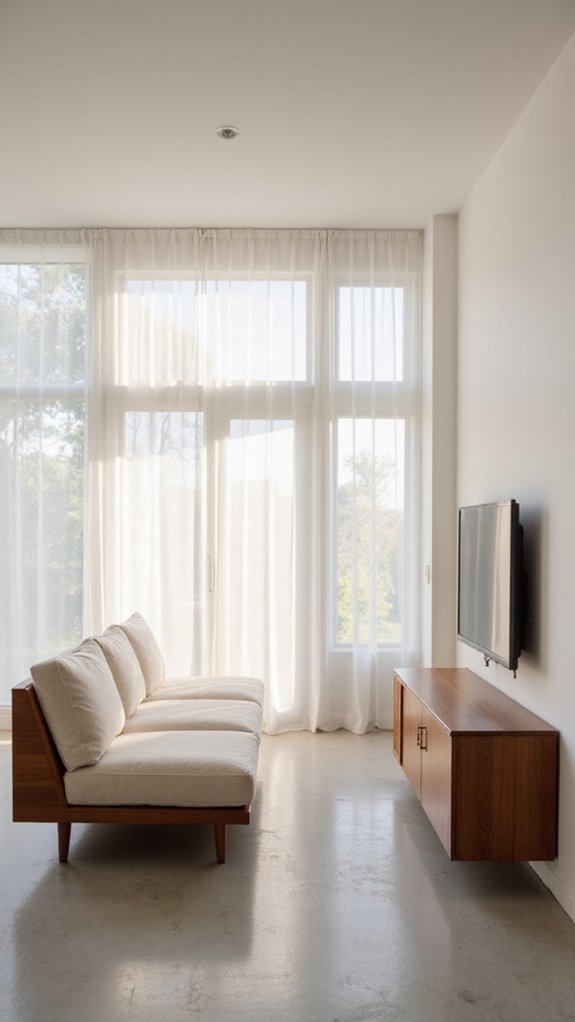
Low-profile furniture selections fundamentally alter perception by reducing visual barriers that fragment sight lines across compact Japandi interiors.
Calculated height positioning below 18 inches creates uninterrupted horizontal planes, allowing natural light to traverse freely.
While maintaining the clean geometric principles essential to minimalist design, this thoughtful approach to furniture elevation establishes visual continuity between zones.
It also helps preserve the serene, uncluttered atmosphere characteristic of successful small-space Japandi implementations.
Strategic placement at varying heights creates enhanced visual interest while respecting the spatial harmony essential to refined interior compositions.
Low Furniture Visual Flow
The implementation of furniture pieces measuring under 18 inches in height creates unobstructed visual corridors that fundamentally transform perception in compact environments.
Low-profile furniture maintains continuous visual flow while supporting space optimization through minimalist design principles.
This approach eliminates visual clutter that typically fragments compact living areas.
Key considerations for ideal visual flow include:
- Platform beds and low sofas that preserve horizontal sight lines across rooms
- Raised storage units with open underneath space maintaining airy atmosphere
- Grounding elements that anchor functional furniture without overwhelming proportions
This methodology enhances space perception through deliberate vertical restraint, creating expansive feelings within confined parameters.
Choose foldable dining tables and stackable stools that can disappear when unused to further enhance the seamless visual flow while maintaining functional flexibility.
Strategic Height Balance
Height balance emerges as a fundamental principle where furniture selection directly influences perception through deliberate vertical positioning.
Low-profile furniture maintains unobstructed sight lines while supporting the minimalist aesthetic through reduced visual clutter and horizontal dominance.
Pieces under eighteen inches optimize natural light flow, creating an airy environment that enhances room boundaries. This calculated balance of height enables effective vertical space utilization without compromising room proportions.
Thoughtful positioning of low sofas, beds, and storage units facilitates seamless sight line continuity, promoting space optimization.
The disciplined approach to furniture elevation ensures tranquil atmospheric conditions while maximizing perceived square footage through intentional design hierarchy.
Balance aesthetics with comfort for everyday use by selecting multi-use decor that maximizes space while maintaining the serene functionality essential to Japandi design principles.
Incorporate Vertical Storage to Optimize Wall Space

Maximizing wall space through vertical storage solutions addresses the fundamental challenge of limited square footage while preserving Japandi design principles of minimalism and visual calm.
Wall-mounted shelves and floating shelves crafted from natural materials create functional storage without compromising open space aesthetics.
Essential vertical storage approaches include:
- Built-in wall niches – Recessed shelving integrates seamlessly into architecture, maintaining horizontal lines
- Multi-tiered cabinets – Tall, slim units maximize storage capacity while preserving openness
- Pegboard systems – Organize everyday items efficiently, eliminating surface clutter
These minimalist storage configurations optimize space utilization through deliberate small-space design strategies, ensuring storage solutions enhance rather than detract from serene environmental qualities.
Mirror-backed shelving units employ strategic light reflection techniques to amplify natural and artificial illumination while maintaining storage functionality.
Add Natural Textures for Warmth and Visual Interest

Natural textures serve as essential design elements that transform sterile minimalist environments into inviting sanctuaries within compact Japandi interiors. Adding textured wood finishes, such as brushed or reclaimed surfaces, creates visual depth while maintaining efficiency.
Thoughtful placement of woven baskets, rattan chairs, and ceramic pottery introduces sensory richness without compromising functionality. Natural stone surfaces with matte finishes provide organic appeal through countertops or accent walls.
Layering linen, wool, jute, and seagrass textiles adds tactile warmth vital for balanced design. Selecting materials in neutral tones ensures cohesive harmony while preventing visual overwhelm in constrained square footage.
Frequently Asked Questions
How Much Should I Budget for a Complete Japandi Small-Space Renovation?
Budget planning for Japandi renovations typically ranges $15,000-$40,000, encompassing material costs, labor expenses, furniture pricing, and design fees. Factor contingency funds at 20%, permit costs, custom pieces, and extended renovation timelines for ideal transformation results.
What Are the Best Plants That Thrive in Singapore’s Humidity for Japandi Spaces?
Singapore’s high humidity suits compact pothos, air purifying ferns, and humidity loving palms for Japandi aesthetics. Low maintenance succulents, shade tolerant begonias, and tropical orchids complement minimalist arrangements while maintaining ideal indoor air quality.
How Do I Maintain Wooden Furniture in Singapore’s Tropical Climate Conditions?
Wood maintenance requires effective moisture management through dehumidifiers, sealed wood finishes, and regular pest prevention treatments. Material selection favoring teak or treated hardwoods, coupled with consistent cleaning routines, guarantees ideal furniture preservation in Singapore’s challenging tropical climate conditions.
Can Japandi Style Work With Existing Tiles or Must I Replace Flooring?
Japandi style accommodates existing tiles through style blending and grout color selection. Tile compatibility depends on pattern matching and durability assessment. Tile cleaning and repair options often eliminate costly replacement needs while maintaining flooring integration.
What Lighting Temperature Creates the Most Serene Japandi Atmosphere at Night?
Warm whites between 2700K-3000K generate ideal serene japandi atmospheres through soft illumination. Dimmable fixtures with amber hue create cozy ambiance, while indirect lighting produces calming glow. Natural tones enhance tranquility better than daylight bulbs.
Final Verdict
These ten Japandi serenity solutions demonstrate how thoughtful planning transforms compact environments into functional sanctuaries.
Through systematic integration of multi-functional elements, vertical optimization, and moisture-resistant materials suited to tropical climates, designers achieve maximum efficiency without compromising aesthetic integrity.
The synthesis of neutral palettes, natural textures, and flexible partitioning systems creates cohesive zones while maintaining visual continuity.
This methodology establishes serene, uncluttered spaces that prioritize both practical functionality and psychological well-being within constrained square footage parameters.
Recommended Products

Muji Acrylic Storage Drawer Units Set
Muji acrylic drawers - Clear storage organizers
VIEW LATEST PRICE
IKEA KALLAX Storage Unit
KALLAX storage cube organizer - Home office storage solutions
VIEW LATEST PRICE
SimpleHouseware Stackable Can Rack Organizer
Stackable can organizer - Pantry organization rack
VIEW LATEST PRICE

