


Interior designers recognize thrifted farmhouse elements as cost-effective solutions for achieving authentic rustic aesthetics.
Careful placement of repurposed agricultural implements, weathered textiles, and vintage storage containers creates layered visual interest within modern living spaces.
These carefully selected pieces establish focal points while maintaining functional utility across various room configurations.
The transformation process requires technical understanding of room proportions, material compatibility, and color coordination to achieve professional results that capture genuine farmhouse character without appearing contrived or overly assembled.
Transform Wooden Tool Totes Into Rustic Storage Solutions

Through targeted repurposing techniques, vintage wooden tool totes emerge as versatile storage solutions that seamlessly integrate farmhouse aesthetics with functional organization.
These thrifted containers, typically acquired for $5–$20, require minimal surface preparation sanding and sealing preserve original patina while ensuring durability.
Internal compartmentalization utilizing scrap wood dividers or mason jars maximizes efficiency for cutlery, craft supplies, or garden implements.
Authentic farmhouse labeling employs chalk paint with deliberate distressing techniques to achieve period-appropriate typography.
Hardware upgrades, including salvaged metal brackets or rope handles, enhance structural integrity while maintaining rustic character.
Wall-mounting configurations with French cleat systems optimize vertical storage capacity.
Begin restoration with gentle soap-and-water cleaning using soft cloths to remove accumulated dust and grime before applying any finishes or protective coatings.
Repurpose Metal Baskets as Charming Centerpieces

Metal baskets retrieved from thrift stores offer exceptional versatility for creating farmhouse-style centerpieces through careful selection and purposeful arrangement.
The transformation process involves identifying structurally sound wire or galvanized containers, applying appropriate surface treatments, and implementing layered styling techniques that maximize visual impact.
Seasonal rotation of basket contents and thoughtful positioning on dining surfaces guarantees these repurposed elements maintain year-round decorative relevance.
Strategic organization by room function maximizes spatial efficiency while wire baskets accommodate both decorative elements and functional storage needs throughout the home.
Finding Perfect Metal Baskets
Where can decorators discover the most versatile foundational elements for farmhouse centerpieces? Thrift stores offer a substantial inventory of wire and galvanized metal baskets suitable for repurposing into distinctive focal points.
Ideal selections include vintage pieces with weathered patinas or newer specimens requiring minimal modification.
Successful sourcing requires evaluating structural integrity, dimensional proportions relative to intended placement surfaces, and existing finish compatibility with target aesthetic schemes.
Wire mesh configurations provide superior drainage for fresh botanical arrangements, while solid-bottomed galvanized options accommodate dry decorative elements effectively. Thoughtful procurement of varied scales enables layered compositions and seasonal rotation capabilities.
Quality thrifted decor pieces exhibit durability essential for repeated styling applications. Transform these metal baskets into visual anchors by incorporating trailing plants or seasonal florals to create farmhouse centerpieces that soften architectural lines while adding organic texture to dining spaces.
Creative Centerpiece Styling Tips
Once acquired, thrifted metal baskets require thoughtful styling techniques to achieve ideal farmhouse centerpiece impact. Prime configuration involves systematic layering approaches that maximize visual depth while maintaining proportional balance across table surfaces.
Essential styling methodologies include:
- Scale variation: Position different-sized baskets at varying elevations to create dimensional hierarchy
- Content diversification: Alternate fresh greenery, seasonal florals, and textural elements for compositional interest
- Hardware customization: Apply distressed finishes or painted accents using vintage-inspired techniques
- Textile integration: Add burlap, lace, or grain-sack materials to enhance rustic authenticity
These thrifted finds transform through deliberate arrangement methods, establishing cohesive farmhouse aesthetics while providing cost-effective table decor solutions that accommodate seasonal rotation requirements.
Layer diverse textures such as velvet, burlap, and metallic accents to create tactile richness that elevates your centerpiece arrangements.
Seasonal Basket Display Ideas
Seasonal shifts present ideal opportunities for reimagining thrifted metal basket configurations through content rotation that maximizes decorative versatility.
Store-sourced pieces from thrift stores and flea markets provide weathered patinas essential for authentic farmhouse aesthetics.
Spring arrangements utilize fresh botanicals within vintage containers, while autumn displays feature pinecones and miniature gourds.
Winter configurations benefit from evergreen sprigs and berry clusters positioned throughout antique basket interiors.
These DIY projects transform basic thrifted home decor into elegant centerpieces through calculated arrangements.
Decor ideas emphasize layered compositions using multiple basket sizes, creating dimensional focal points that adapt seamlessly across seasonal transitions while maintaining consistent rustic charm throughout yearly cycles.
Strategic material selection and compositional balance achieve professional-quality results on a budget while transforming discarded items into personalized vintage displays.
Create Authentic Display Pieces With Stoneware Crocks

While modern farmhouse lovers often struggle to achieve genuine rustic authenticity, thoughtfully adding thrifted stoneware crocks establishes immediate visual credibility within planned display arrangements.
These weathered vessels, typically sourced from thrift stores and flea markets at $10-30 price points, function as versatile display anchors across various room configurations:
- Position distressed stoneware crock specimens on open shelving systems to create visual weight and textural contrast
- Repurpose vintage-marked vessels as functional storage for kitchen utensils and culinary implements
- Integrate chipped or weathered pieces into tabletop vignettes for enhanced rustic patina effects
- Layer multiple crock sizes within display groupings to establish dimensional focal points
For outdoor farmhouse displays, select crocks constructed from materials that can withstand weather-resistant conditions while maintaining their authentic aged appearance across seasons.
Turn Galvanized Cake Pans Into Floating Shelves

Galvanized cake pans possess inherent structural properties that make them suitable candidates for wall-mounted floating shelf applications in farmhouse-style interiors.
The selection process requires evaluation of dimensional consistency, surface integrity, and metal thickness to guarantee adequate load-bearing capacity once mounted.
Proper hardware specification and mounting techniques become critical factors in achieving both functional stability and the desired aesthetic integration within existing wall configurations.
These repurposed galvanized containers can be filled with seasonal plants like mums or ornamental grasses to create functional rustic planters that enhance the farmhouse aesthetic while providing practical storage solutions.
Selecting Quality Cake Pans
How can one distinguish between galvanized cake pans suitable for structural repurposing versus those destined for disposal?
Antique galvanized cookware requires meticulous evaluation to guarantee superior wall-mounting performance. Structural integrity supersedes aesthetic appeal when transforming these vessels into load-bearing shelving systems.
Essential assessment criteria include:
- Surface corrosion patterns – minimal oxidation indicates preserved metal thickness
- Dimensional stability – absence of warping ensures proper bracket alignment
- Rim condition – intact edges provide secure mounting points
- Base integrity – solid construction prevents failure under distributed loads
Professional restoration techniques involve thorough surface preparation through abrasive cleaning, followed by protective coating application.
Heavy-duty anchoring systems must accommodate both pan weight and anticipated shelf loads for safe installation.
When properly mounted, these repurposed cake pans function as floating shelving systems that maintain visual flow while maximizing storage capacity in compact spaces.
Mounting and Hardware Tips
Once appropriate galvanized cake pans have been identified and assessed for structural viability, proper mounting hardware selection becomes the determining factor in achieving professional-grade floating shelf installations. L-brackets secured with screws provide ideal load distribution across pan surfaces.
Wall studs offer superior anchoring compared to drywall anchors when supporting decorative items in living room applications. Thrift store finds require careful spacing calculations to ensure balanced weight distribution.
Antique stores often yield quality pans, though yard sales provide budget alternatives. Heavy-duty mounting systems accommodate books and plants effectively.
Professional installations demand precise measurements and appropriate weight-capacity ratings for long-term structural integrity and safety compliance.
These converted galvanized shelves work particularly well when styled with woven baskets and natural materials to create layered textures throughout the farmhouse living space.
Add Texture With Burlap Sacks and Grain Sack Stripes
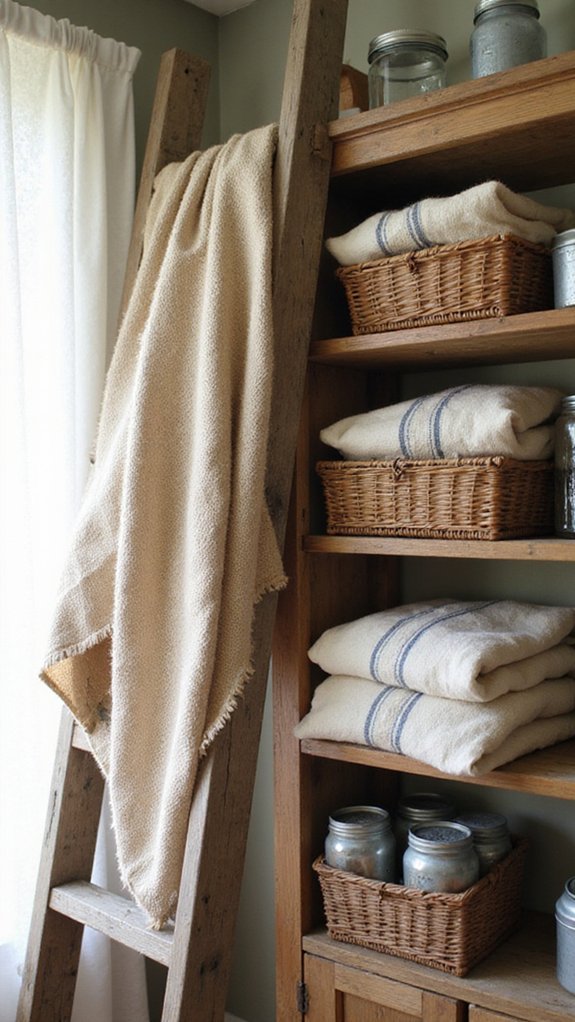
Adding burlap sacks and grain sack stripes introduces essential textural complexity to farmhouse interiors through their distinctive woven surface properties and linear design elements.
Thrift store acquisitions provide cost-effective material sources for transforming vintage grain sacks into functional decor components.
The natural fiber composition creates visual contrast against weathered wood surfaces and distressed paint finishes.
Implementation methods include:
- Converting salvaged burlap into upholstered accent pieces and pillow covers
- Utilizing grain sack stripes for table runners and window treatments
- Creating wall-mounted textile displays for vertical interest
- Developing handcrafted placemats maintaining authentic farmhouse aesthetics
These applications establish cohesive layered environments characteristic of traditional agricultural spaces.
Natural burlap materials can also be repurposed into hanging planter liners, where coconut fiber liners provide superior drainage and complement the organic textures found throughout farmhouse-style spaces.
Convert Vintage Washboards Into Functional Wall Decor

Why discard functional antiques when vintage washboards offer exceptional opportunities for architectural integration within farmhouse environments?
Washboard Revival transforms corrugated metal surfaces into compelling wall installations through systematic hardware removal and surface preparation.
Careful placement utilizing D-rings ensures ideal load distribution across mounting points. Enhanced dimensional character emerges through selective paint applications or stenciled botanical motifs, amplifying authentic patina effects.
These vertical elements establish focal hierarchy within entryways, utility spaces, and culinary zones while maintaining structural integrity. Coordinated arrangements with complementary textile displays create cohesive narratives.
The embossed metalwork provides tactile contrast against smooth wall planes, generating refined textural interplay throughout interior compositions.
Consider incorporating chunky throws or plaid patterns in autumn colorways alongside washboard displays to extend the layered textile approach from exterior porch styling into interior farmhouse spaces.
Upcycle Library Card Catalogs for Multi-Drawer Organization

Vintage library card catalogs represent exceptional thrifted acquisitions for farmhouse interior design. They are typically available at estate sales and thrift establishments for under fifty dollars.
These multi-drawer storage systems require transformation techniques including surface preparation, paint application, and hardware replacement to achieve authentic farmhouse aesthetics.
The compact drawer configuration provides ideal organization for small-item storage applications, from craft supplies and jewelry to kitchen spices and collectible hardware.
Position these repurposed pieces with wicker baskets and wooden trays to create versatile table organization zones that enhance the farmhouse aesthetic while maintaining functional accessibility.
Finding Card Catalogs
When sourcing authentic library card catalogs for farmhouse upcycling projects, collectors should focus on identifying units constructed from solid hardwood or steel that exhibit the characteristic multi-drawer configuration typical of mid-20th century library organization systems.
Prime sourcing locations include:
- Estate sales and library decommissioning auctions
- Antique dealers specializing in institutional furniture
- Salvage yards focusing on architectural elements
- Online marketplaces with verified vintage classifications
Collectors should examine drawer mechanisms for smooth operation, assess structural integrity of joints, and verify authentic hardware details.
Early 20th century specimens often feature brass pulls and hand-stamped indexing systems, distinguishing genuine pieces from modern reproductions lacking historical provenance.
These repurposed card catalogs work exceptionally well with warm earth tones and natural wood finishes to create the perfect farmhouse aesthetic while providing practical multi-drawer storage solutions.
Upcycling Transformation Techniques
The transformation process for library card catalogs begins with thorough surface preparation, requiring systematic disassembly of drawers and hardware components to access all structural elements.
Cleaning eliminates accumulated debris while progressive sanding creates ideal paint adhesion on wood or metal substrates.
Farmhouse-appropriate color application follows established surface protocols, with distressing techniques enhancing authentic weathered characteristics.
Vintage hardware installation replaces deteriorated components, adding period-appropriate pulls and label holders that complement rustic aesthetics.
Final matte or satin topcoat application provides protective sealing while preserving distressed visual elements.
Thoughtful placement within kitchen, entryway, or laundry room configurations maximizes functional storage capacity while maintaining authentic farmhouse character throughout interior spaces.
Position these repurposed units in corners to define spatial boundaries and anchor seating arrangements while creating functional zones that complement your farmhouse decor scheme.
Organization Storage Solutions
Library card catalogs transformed into multi-drawer organizational systems deliver exceptional storage density within compact footprints, making them ideal solutions for space-constrained farmhouse interiors.
These vintage units accommodate diverse organizational requirements while maintaining architectural integrity.
Placement considerations include:
- Kitchen applications for utensil categorization and small appliance storage
- Craft room configurations maximizing vertical storage capacity
- Office environments requiring compartmentalized filing systems
- Garden decor storage for seasonal accessories and maintenance supplies
Surface treatments through distressing or paint application integrate seamlessly with existing farmhouse aesthetics. Installation of labeled identification systems optimizes retrieval efficiency while preserving authentic vintage character throughout multi-functional spaces.
The minimal clutter approach ensures each compartment maintains breathing room while maximizing both storage efficiency and visual appeal.
Frame Antique Quilts Using Vintage Window Frames

Although conventional picture frames often overwhelm the intricate patterns of antique quilts, vintage window frames provide an ideal solution by offering substantial visual weight that complements rather than competes with the textile’s craftsmanship.
This repurposing technique creates dimensional wall installations while preserving the quilt’s heritage aesthetic.
| Preparation Method | Securing Technique |
|---|---|
| Strip existing paint | Upholstery tacks |
| Apply complementary finish | Metal clips |
| Sand weathered surfaces | Backing attachment |
| Preserve patina elements | Direct sewing |
Window frames require careful color coordination to enhance the quilt’s palette. The resulting layered presentation transforms both salvaged architectural elements and textile heirlooms into cohesive farmhouse focal points that celebrate traditional craftsmanship.
Style Weathered Wood Pieces as Rustic Shelving

Where conventional shelving solutions often appear too polished for authentic farmhouse interiors, weathered wood pieces salvaged from barns, pallets, and dismantled structures provide the precise patina and dimensional character required for rustic installations.
Wood weathering creates natural surface variations that manufactured materials cannot replicate.
Authentic farmhouse shelving demands weathered wood’s natural patina—something manufactured materials simply cannot replicate with genuine rustic character.
The restoration process involves careful preparation:
- Clean surfaces while preserving existing patination and texture
- Sand minimally to maintain authentic weathering characteristics
- Install robust metal brackets positioned on structural wall studs
- Add mismatched wood dimensions for layered visual interest
Mounting reclaimed lumber on exposed brackets emphasizes utilitarian aesthetics while delivering functional storage capacity throughout kitchen, pantry, and living spaces.
Design Cotton Boll Wreaths for Seasonal Door Accents

Why settle for mass-produced seasonal decorations when cotton boll wreaths offer authentic farmhouse character through careful selection of thrifted materials? Thrift stores and flea markets provide vintage cotton stems and decorative elements essential for seasonal crafting projects.
Construct wreaths by positioning cotton stems systematically around wire or grapevine bases, securing attachment points with hot glue or floral wire. Enhance rustic aesthetics through thoughtful placement of burlap ribbons, weathered wood accents, and vintage signage.
Adapt wreaths seasonally by adding appropriate greenery, flowers, or ornaments while preserving farmhouse appeal. This methodical approach transforms budget-conscious thrifted materials into elegant door accents.
Frequently Asked Questions
What Decor Style Is Replacing a Farmhouse?
Modern Minimalism is chiefly replacing farmhouse aesthetics in interior design. This paradigm shift emphasizes clean geometric lines, neutral color palettes, and uncluttered configurations, effectively displacing the layered textures and rustic elements characteristic of traditional farmhouse styling.
Is Farmhouse Decor Still in Style in 2025?
Yes, farmhouse decor remains stylistically relevant in 2025, experiencing a Vintage Revival through sustainable design integration. Modern implementations emphasize reclaimed materials and selected vintage elements, maintaining the aesthetic’s warmth while adapting to evolving environmental consciousness and material sourcing preferences.
How to Make Something Look Farmhouse Style?
Achieving rustic charm requires implementing distressed finishes through targeted sanding, applying weathered paint techniques, adding reclaimed materials, utilizing neutral color palettes, and integrating vintage hardware to establish authentic patina and dimensional texture throughout design elements.
What Is the Difference Between Farmhouse and Country Decor?
Farmhouse decor emphasizes minimalistic rustic charm with neutral palettes and streamlined vintage elements, while country decor features ornate traditional patterns, vibrant colors, and elaborate decorative accessories throughout interior spaces.
Final Verdict
Implementation of these thrifted farmhouse elements creates cohesive arrangements through deliberate material juxtaposition and functional integration.
The systematic addition of weathered textures, galvanized metals, and reclaimed wood establishes visual continuity while maximizing vertical storage capacity.
These vintage components facilitate ideal room functionality through multi-purpose applications, generating cost-effective interior solutions.
The methodical placement of repurposed artifacts enhances depth and maintains authentic farmhouse aesthetics within modern residential environments.
Recommended Products

Benjamin Moore Advance Interior Paint in Swiss Coffee (Warm White) 1-Gallon
Warm white interior paint - Soft white paint farmhouse
VIEW LATEST PRICE
Color Wheel for Interior Designers Professional Size
Interior design color wheel - Decorator color theory tool
VIEW LATEST PRICE
Moroccan Beni Ourain Handwoven Wool Rug 6x9 Authentic Berber
Beni ourain rug authentic - Moroccan wool rug handwoven
VIEW LATEST PRICE

