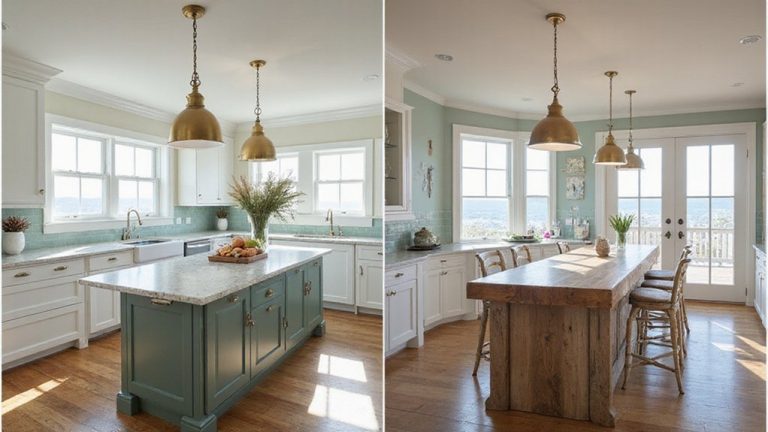


Interior designers recognize that summer dining spaces require strategic modifications to maximize comfort and aesthetic appeal during warmer months.
Successful seasonal transformations rely on fundamental design principles including color temperature theory, natural light optimization, and textural contrast.
These evidence-based approaches create environments that respond to both physiological and psychological needs for coolness and relaxation.
Professional implementation of specific techniques can dramatically alter spatial perception and atmospheric quality, yet most homeowners overlook critical elements that distinguish amateur attempts from expertly curated summer sanctuaries.
Also read this: Indoor-Outdoor Home Decor Ideas
Embrace Light and Neutral Color Palettes as Your Foundation
The strategic implementation of light and neutral color palettes establishes a sophisticated foundation for summer decor, leveraging chromatic principles that maximize spatial perception and luminosity.

Light colors including beige, cream, white, and soft gray generate airy atmospheres while enhancing natural light reflection properties.
This neutral palette methodology creates ideal conditions for seasonal accent integration, allowing vibrant summer elements to achieve visual prominence.
Textural layering through wicker, linen, and natural wood components introduces dimensional complexity within the monochromatic framework.
The resulting chromatic foundation delivers temporal versatility, accommodating diverse thematic variations while maintaining cohesive design integrity throughout seasonal transitions and stylistic adaptations.
Also read this: 10 Must-Try Winter Living Room Decor Ideas
Create Stunning Centerpieces With Fresh Seasonal Flowers
Five fundamental design principles govern the creation of impactful floral centerpieces that serve as commanding focal points within summer dining environments.

Strategic selection of oversized blooms like peonies and hydrangeas establishes visual dominance when housed in proportionate vessels.
Vertical elements through delphiniums or snapdragons create architectural structure within compositions.
- Incorporate seasonal summer flowers including zinnias, daisies, and roses in transparent glass vessels for chromatic vibrancy.
- Integrate organic foliage such as eucalyptus or fern fronds to achieve textural depth and dimensional fullness.
- Maintain low-profile floral arrangements to preserve sightlines across dining surfaces.
- Utilize elevated platforms or tiered displays to generate dynamic visual hierarchy.
Also read this: Top 5 Fall Office Decor Ideas to Bring Autumn Indoors
Bright colors, natural textures, and sunshine-filled corners your summer dining room should feel like a fresh breeze at the table.
Incorporate Natural Textures Through Wicker and Wood Accents
Beyond floral arrangements, foundational textural elements establish the tactile framework that defines sophisticated summer dining environments.

Natural textures through wicker and wood accents create dimensional layering that elevates casual dining aesthetics.
Wicker baskets and trays introduce organic weaving patterns while maintaining visual lightness essential for seasonal spaces.
Wood elements rustic tables, coasters, decorative accessories provide grounding warmth that balances wicker’s airy qualities.
Woven placemats in rattan or seagrass amplify tactile interest without overwhelming spatial harmony. Strategic layering of these organic materials generates cohesive textural narratives.
Complementary natural fiber textiles, including linen and burlap, further enhance the tactile richness of summer dining environments.
Also read this: Best Summer Living Room Cooling Ideas
Add Vibrant Touches With Seasonal Fruits and Greenery
Seasonal produce and living botanical elements serve as dynamic focal points that infuse dining spaces with organic color palettes and textural contrast.

Citrus-filled planter boxes function as both decorative vessels and aromatic design elements, establishing visual weight through their saturated hues and geometric containment systems.
Fresh herb garden displays integrate utilitarian landscaping principles with interior aesthetics, creating multi-sensory environments that engage both visual and olfactory perception.
Citrus-Filled Planter Boxes
Citrus-filled planter boxes serve as dynamic focal points that introduce organic color palettes and natural fragrance into summer dining environments.
These arrangements utilize bright lemons, limes, and oranges to establish vibrant visual anchors within outdoor dining configurations. Strategic placement creates balanced compositions that enhance spatial dynamics.
- Foundation Construction: Implement floral foam or moss substrates to create elevated, mounded bases that provide structural stability for citrus fruits and botanical elements.
- Aromatic Integration: Incorporate fragrant herbs like basil, mint, and thyme to amplify olfactory appeal while adding textural contrast.
- Layered Botanical Design: Combine leafy greens, succulents, and flowering plants for dimensional depth.
- Container Selection: Choose rustic wooden or galvanized metal planter boxes for authentic garden aesthetics.
Fresh Herb Garden Displays
How can dining spaces achieve sophisticated botanical integration while maintaining functional accessibility?
Fresh herb garden displays establish dynamic focal points through strategic placement of aromatic specimens including basil, mint, and thyme.
These living installations incorporate natural elements via rustic wooden or terracotta vessels, creating textural depth and organic authenticity.
Positioning arrangements adjacent to light sources ensures ideal photosynthetic conditions while maximizing visual luminosity.
Complementary seasonal fruits lemons, limes, strawberries enhance chromatic vibrancy within the composition.
Cut herb arrangements in water-filled vessels provide low-maintenance centerpiece solutions.
This systematic approach transforms dining environments into immersive garden-inspired spaces, elevating summer decor through purposeful horticultural integration and sensory engagement.
Also read this: Winter Deck Safety and Maintenance
Use Trays and Baskets for Versatile Table Organization
Strategic placement of trays and baskets transforms dining table surfaces into organized zones while introducing essential textural contrast.

Wicker and woven materials establish casual, summery atmospheres while maintaining functional accessibility.
Layering multiple vessels creates dimensional hierarchy through varying heights and textures, effectively defining distinct spatial areas.
This systematic approach facilitates versatile styling configurations on dining and kitchen island surfaces.
Strategic vessel arrangement establishes functional zones through dimensional contrast, creating sophisticated organizational systems for dynamic surface styling.
- Contain decorative elements like candles and greenery within defined boundaries for cohesive visual organization
- Layer multiple trays at different elevations to establish visual depth and spatial definition
- Maintain minimal styling within each vessel to preserve clean, uncluttered aesthetics
- Position strategically for ideal accessibility and functional table organization
Scatter Delicate Flower Petals for Romantic Ambiance
Incorporating scattered flower petals creates an organic romantic layer that transforms summer dining spaces through strategic material selection and precise placement methodology.

Fresh petal selection requires consideration of bloom durability, color harmony, and fragrance intensity to achieve best visual and sensory impact.
Proper arrangement techniques involve systematic distribution patterns that complement existing table elements while maintaining natural flow and proportional balance.
Fresh Petal Selection Tips
When selecting petals for scattered table arrangements, designers prioritize delicate varieties that maintain structural integrity while providing ideal visual impact.
Rose petals, hydrangea blooms, and miniature violets exemplify optimal choices for natural decor applications.
Professional florists recommend sourcing fresh petals from established floral arrangements or premium grocery store bouquets, ensuring chemical-free specimens that enhance sensory engagement.
- Petal preparation: Gently separate larger blossoms into individual components for organic distribution patterns
- Quality assessment: Select dry, clean specimens free from pesticide contamination
- Variety selection: Choose soft-textured blooms like roses, hydrangeas, or violets for romantic aesthetics
- Fragrance consideration: Prioritize aromatic varieties to elevate dining atmosphere
Arrangement and Placement Techniques
The artful distribution of flower petals across dining surfaces requires deliberate consideration of visual weight, texture balance, and spatial flow to achieve ideal romantic ambiance.
Strategic placement involves clustering petals around focal points while creating organic trails that guide the eye naturally across the tablescape.
The arrangement should incorporate varied petal sizes from roses and hydrangeas, distributed in asymmetrical patterns that maintain visual equilibrium without oversaturation.
Perfect placement zones include centerpiece perimeters and table edges, establishing layered depth through controlled scattering techniques.
This methodical approach ensures a sophisticated romantic atmosphere while preserving the table’s functional accessibility and elegant restraint.
Also read this: 7 Must-Have Modern Christmas Decor Ideas for 2025
Choose Simple Elegant Tableware to Avoid Clutter
Simple, elegant tableware forms the foundation of sophisticated summer dining room aesthetics by eliminating visual distractions and establishing clean design lines.

Minimalistic table setting principles emphasize streamlined porcelain and matte-finish surfaces that create visual cohesion.
Streamlined porcelain and matte surfaces eliminate visual clutter while establishing the clean, sophisticated foundation essential for elevated summer dining aesthetics.
Strategic color palette limitation through neutral tones maintains spatial harmony while reducing cognitive load.
Summer dining decor benefits from unembellished dinnerware that prioritizes functional geometry over decorative complexity.
- Select white porcelain or matte-finish dishes for clean, sophisticated visual impact
- Implement limited color palettes using neutral tones or soft pastels for visual calm
- Choose unembellished dinnerware without excessive patterns to maintain understated elegance
- Incorporate lightweight, stackable pieces paired with natural fiber placemats for refined texture
Maximize Natural Light With Reflective Surfaces
Strategic implementation of reflective surfaces amplifies natural light penetration while creating visual depth within the dining space.
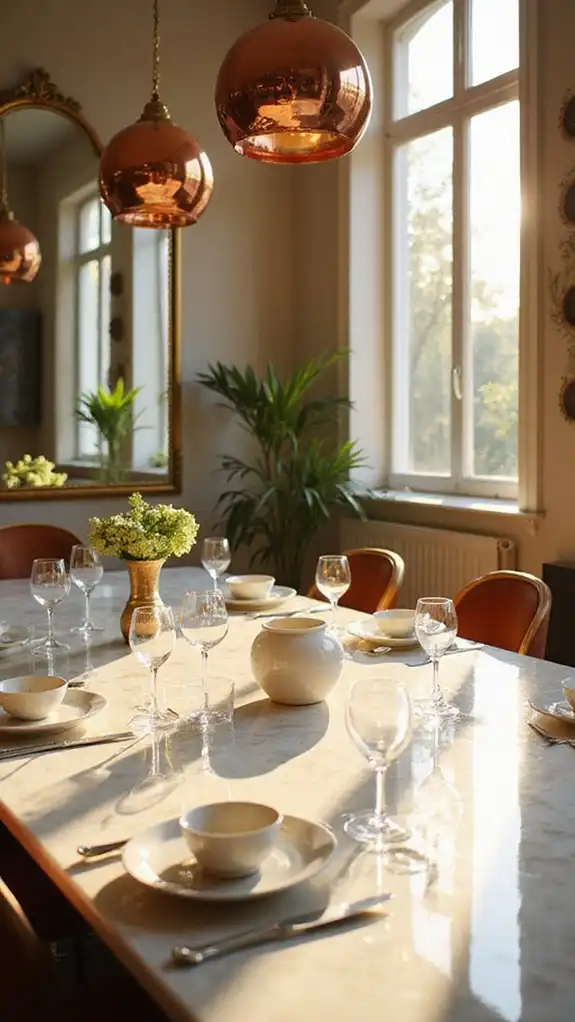
Proper mirror positioning opposite windows establishes light multiplication pathways that enhance overall luminosity and spatial perception.
The integration of glass elements and metallic accents creates a cohesive reflective framework that maximizes photonic distribution throughout the room’s interior surfaces.
Mirror Placement Strategy Tips
How can homeowners effectively harness natural light to transform their dining spaces during the warmer months?
Strategic mirror placement maximizes illumination through calculated positioning and reflective surface optimization.
Proper mirror placement in the dining room creates luminous environments that enhance spatial perception while reducing artificial lighting dependency.
Effective natural light amplification requires systematic approaches:
- Position large mirrors opposite windows to double incoming sunlight and eliminate shadow zones
- Install wall-mounted mirrors behind dining tables to create depth illusion and spatial expansion
- Deploy multiple smaller mirrors with varied frames for uniform light distribution patterns
- Select distortion-free reflective surfaces to maintain authentic environmental reflections and preserve ambient quality
Glass Table Centerpiece Ideas
Three fundamental principles govern glass centerpiece selection for ideal light reflection: transparency, surface quality, and strategic positioning.
Clear glass vases and bowls maximize photon transmission while creating luminous focal points in the summer dining room.
Mirrored trays beneath centerpieces amplify reflective surfaces, effectively doubling available natural light.
Semi-transparent containers showcase floral arrangements while maintaining optical clarity.
| Glass Centerpiece Type | Light Enhancement Effect |
|---|---|
| Clear glass vases | Direct light transmission |
| Mirrored serving trays | Surface amplification |
| Crystal bowls | Light refraction patterns |
| Glass candle holders | Reflected illumination |
| Acrylic display stands | Visual weight reduction |
Strategic arrangement of glass table centerpiece elements creates cohesive lighting systems that transform ambient illumination into dynamic design features.
Metallic Accent Integration Methods
Metallic accents function as sophisticated light amplification systems that harness natural illumination through calculated reflective positioning.
Strategic placement of gold and silver elements opposite windows creates ideal light bouncing trajectories throughout the dining space.
Reflective surfaces such as mirrored tabletops and metallic-backed glassware maximize brightness distribution while establishing luminous focal points.
High-gloss finishes enhance light reflection coefficients, producing elegant visual depth.
The integration methodology requires pairing metallic components with light-colored foundational elements to optimize reflective performance and achieve maximum luminosity amplification.
- Position metallic trays and candlesticks directly opposite primary light sources
- Select high-gloss metallic finishes for superior light reflection capabilities
- Incorporate mirrored surfaces on tabletops and serving accessories
- Coordinate metallic accents with light-toned walls for enhanced brightness optimization
Also read this: 7 Fall Front Walkway Decor Ideas You Should Try This Season
Create Layered Displays With Two-Tier Arrangements
The strategic implementation of two-tier arrangements transforms conventional dining room centerpieces through vertical layering principles that maximize visual impact within confined table space.

These elevated configurations utilize pedestals, vintage cake stands, and tiered platforms to establish dimensional hierarchy within centerpiece displays.
The integration of contrasting heights creates dynamic focal points while ceramic and wooden bases provide structural versatility for seasonal rotations.
Complementary elements positioned across multiple levels generate sophisticated visual depth through strategic placement methodology.
Maintaining proportional balance between upper and lower tier components ensures cohesive integration with surrounding tablescapes, while layered decor systems optimize spatial efficiency during summer entertaining scenarios.
Mix Potted Plants With Cut Flowers for Lasting Beauty
How effectively can dining room centerpieces balance immediate visual impact with sustained seasonal appeal?

Combining potted plants with cut flowers creates sophisticated layered arrangements that maintain visual interest for extended periods.
This hybrid approach leverages the ephemeral beauty of fresh blooms while establishing a foundational framework through living specimens.
- White hydrangeas in matching containers serve as focal anchors alongside rotating seasonal cut flowers
- Potted herbs and succulents provide textural contrast and aromatic elements to floral compositions
- Identical vessel selection ensures cohesive aesthetic unity between permanent and temporary botanical elements
- Easy-care houseplants like Swedish Ivy maintain centerpiece integrity between fresh flower rotations
Final Verdict
These summer dining room applications demonstrate fundamental design principles of balance, proportion, and harmony through strategic material selection and spatial organization.
The integration of neutral palettes with organic textures creates visual cohesion while maximizing luminosity through reflective surfaces.
Layered arrangements establish depth and dimensional interest, while systematic organization maintains functional clarity.
This exhaustive approach to seasonal interior transformation ensures ideal aesthetic impact through deliberate coordination of color theory, natural elements, and architectural lighting considerations.
FAQs
Recommended Products

Havenly Interior Design Service Gift Card $200-500
Interior design service - Home decorating consultation
VIEW LATEST PRICE
Color Wheel for Interior Designers Professional Size
Interior design color wheel - Decorator color theory tool
VIEW LATEST PRICE
Wagner Spraytech Studio Home Decor HVLP Paint Sprayer
Wagner paint sprayer - HVLP sprayer interior
VIEW LATEST PRICE