

Interior designers increasingly recognize the synergistic potential between Scandinavian hygge principles and Japanese wabi-sabi philosophies, creating spaces that prioritize both functional efficiency and meditative tranquility.
This fusion aesthetic, commonly termed “Japandi,” requires precise planning and material selection to achieve ideal visual balance.
The methodology involves elimination of non-essential elements while emphasizing natural textures and neutral chromatic schemes.
Mastering this approach demands understanding specific proportional relationships and lighting techniques that transform conventional interiors into serene, purposeful environments.
Embrace the Fusion of Scandinavian Functionality and Japanese Minimalism

While Scandinavian design emphasizes functional simplicity and Japanese aesthetics champion deliberate minimalism, their convergence creates the Japandi style a refined design methodology that prioritizes efficiency through targeted material selection and geometric restraint.
This interior design style merges Nordic hygge principles with Japanese wabi-sabi philosophy, establishing balanced compositions through asymmetrical arrangements and intentional negative space.
The fusion leverages Scandinavian cool-toned palettes alongside Japanese warm earth elements, creating visual tension through complementary contrasts.
Each architectural element maintains dual functionality, ensuring purposeful placement within hierarchies while eliminating superfluous ornamentation that compromises the environment’s meditative qualities and ergonomic flow patterns.
Strategic implementation of negative space creates compositional balance while highlighting focal points and supporting the meditative atmosphere essential to both design philosophies.
Clear Clutter and Create Well-Curated Spaces

The elimination of visual disorder forms the cornerstone of effective Japandi implementation, requiring systematic storage methodologies that conceal functional necessities while preserving clarity.
Built-in cabinetry and minimalist containment systems effectively mitigate clutter accumulation while maintaining aesthetic coherence.
Decorative elements demand thoughtful selection, choosing objects that provide functional utility or promote psychological tranquility.
Daily maintenance protocols ensure surface areas remain unencumbered, supporting harmony through consistent organizational practices.
Neutral chromatic palettes reduce visual interference, while simplified geometries in furnishing selections contribute to environmental serenity.
This methodical approach to organization creates deliberately composed interiors that embody both Scandinavian pragmatism and Japanese contemplative principles.
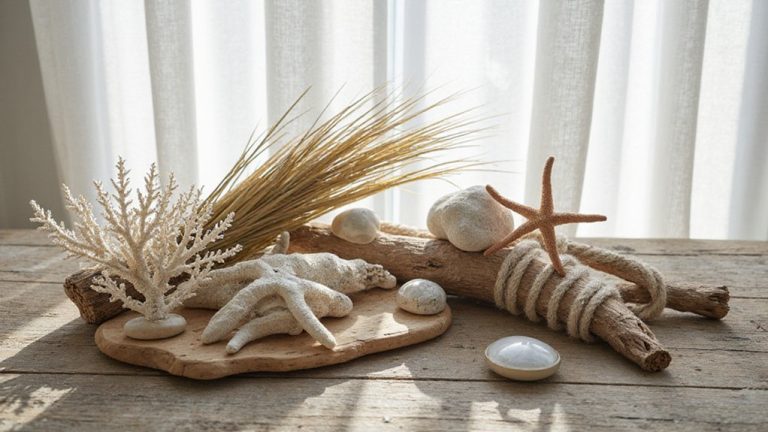
Repurposed glassware and ceramic pieces serve as elegant foundations for seasonal arrangements while maintaining the clean aesthetic principles essential to this design philosophy, demonstrating how selective decoration placement can enhance rather than compromise minimalist spaces.
Master the Japandi Color Palette With Neutral Tones and Black Accents

The Japandi aesthetic relies on a carefully orchestrated color strategy that establishes neutral tones as the foundational framework while adding deliberate black elements to create visual hierarchy and definition.
This approach requires balancing Scandinavian cool grays and muted blues with Japanese warm earth tones, ensuring tonal cohesion across all surface planes and architectural elements.
The deliberate placement of black accents functions as both contrast mechanism and compositional anchor, defining focal points within the minimalist arrangement.
Incorporating natural materials like wood and stone alongside these neutral palettes adds thermal and textural contrast that prevents monotony while maintaining the serene aesthetic foundation.
Neutral Base Color Foundation
How does one establish the foundation for authentic Japandi aesthetics? The foundation begins with carefully selected neutral colors that merge Scandinavian and Japanese design philosophies.
Interior design professionals recommend establishing a base palette using soft grays, muted blues, warm beiges, and tans. These neutral tones create harmony while maintaining the minimalist principles central to Japandi style.
The color foundation serves multiple functions: providing visual continuity throughout rooms, enhancing natural light distribution, and creating psychological calm.
This neutral backdrop allows architectural elements and furnishings to achieve prominence without competing for attention, establishing the essential framework for Scandinavian-Japanese decor integration.
Complement this foundation with natural materials like reclaimed wood and stone accents to introduce organic textures that enhance the tactile variation essential for authentic minimalist layering.
Strategic Black Accent Placement
While neutral foundations establish visual harmony, targeted black accent positioning transforms Japandi interiors from bland monochromatic schemes into refined compositions with deliberate contrast points.
Black accents function as visual anchors within light-toned environments, creating dimensional hierarchy through calculated positioning.
Professional designers leverage these darker elements to establish focal points while preserving minimalist aesthetic principles.
- Picture frames and curtain rods create striking linear contrasts against neutral walls
- Side tables and ceramic vases introduce sculptural depth without material dominance
- Pendant lights and floor lamps emphasize geometric forms through shadow play
- Cushions and decorative objects balance warm-cool temperature relationships
- Careful distribution ensures harmonic composition rather than visual fragmentation
Strategic black placement mirrors the principles of cohesive color palette selection, where thoughtful distribution prevents visual clutter while maintaining sophisticated design unity throughout living spaces.
Warm-Cool Tone Balance
Achieving ideal warm-cool tone equilibrium requires systematic color temperature distribution across architectural planes and furnishing elements.
The Japandi color palette strategically positions Scandinavian cool tones soft blues and greys across larger surfaces while introducing Japanese warm earthy shades through textiles and accent pieces.
Natural materials like wood and ceramics bridge temperature disparities, creating seamless gradations between thermal zones. Darker woods and black metal fixtures establish visual anchoring points, preventing thermal imbalance.
Successful implementation involves layering cool neutrals on walls and primary surfaces, then introducing warm tans and browns through furniture and decorative elements. This approach ensures neither temperature dominates the overall composition.
When incorporating textiles like area rugs into your Japandi palette, ensure complete drying after cleaning to maintain their color integrity and prevent deterioration that could disrupt your carefully balanced warm-cool tone scheme.
Incorporate Natural Materials Like Wood, Linen, and Ceramics

Natural materials form the structural foundation of authentic Japandi design, requiring careful selection and placement to achieve ideal harmony.
Wood elements establish the primary material framework through furniture and architectural accents, while linen textiles introduce complementary softness across upholstery and window treatments.
Ceramic components complete the material triad by providing sculptural focal points and functional accessories that reinforce the organic aesthetic throughout the interior environment.
Like strategic organic mulch application that creates protective barriers while maintaining natural beauty, these materials work together to insulate your space from visual chaos while contributing to the gradual development of a serene atmosphere.
Wood Selection and Placement
The foundation of successful Japandi design lies in selecting wood species that embody both Scandinavian durability and Japanese reverence for natural materials. This Scandinavian interior approach prioritizes sustainably sourced oak, walnut, and cedar for authentic texture integration.
Thoughtful placement creates harmony while maintaining minimalist principles essential to Scandinavian style aesthetics.
- Choose native wood species like oak and walnut for authentic Scandinavian Japanese interior design integrity
- Include low-profile wooden furniture with clean geometries to emphasize craftsmanship over ornamentation
- Apply matte or light stain finishes to preserve natural grain patterns and warmth
- Position wooden elements thoughtfully in cabinetry and shelving for visual continuity
- Combine wood with ceramics and linen to achieve textural depth
Enhance vertical spaces with floating shelves crafted from matching wood species to maintain design consistency while providing functional storage throughout your living areas.
Linen Textile Integration
Linen textiles serve as the connective tissue between Japandi design’s foundational wooden elements and ceramic accents, introducing tactile softness that balances harder material surfaces.
These natural materials bridge Scandinavian design functionality with Japanese style aesthetics through breathable upholstery and bedding applications.
Cushions, throws, and curtains in neutral tones establish room hierarchy while maintaining minimalist decor principles. The fabric’s inherent wrinkled texture embodies wabi-sabi philosophy, celebrating imperfection within controlled compositions.
Undyed or lightly pigmented linen preserves the earthy palette essential to authentic Japandi environments, creating visual continuity between textile elements and surrounding organic materials while enhancing atmospheric tranquility through understated elegance.
Layer patterned throw pillows with solid-colored foundations to create visual depth while maintaining the serene aesthetic central to solution-dyed acrylic fabrics for enhanced durability in natural light environments.
Ceramic Accent Choices
Ceramic elements function as sculptural anchors within Japandi interiors, their mineral composition providing essential weight and grounding against the lighter visual presence of linen and wood components.
Handcrafted ceramic pieces with natural, earthy glazes introduce subtle textural variation while maintaining harmony. Placement of stoneware vessels in neutral palettes—beige, gray, black—creates understated focal points without visual competition.
Like container gardens that layer different textures and heights, ceramic arrangements benefit from dimensional placement that creates visual depth while maintaining minimalist principles.
- Select ceramic dishware emphasizing Japanese minimalism and Scandinavian functionality
- Add stoneware vases in neutral tones for understated anchoring
- Pair ceramic accents with wood elements to enhance organic tactile qualities
- Choose handcrafted pieces with earthy glazes for textural warmth
- Utilize ceramic planters combining horticultural function with aesthetic balance
Choose Low-Profile Furniture With Clean Lines

Selecting furniture with horizontal emphasis fundamentally transforms perception within Japandi interiors, as low-profile pieces create visual continuity that extends sightlines across the room.
Coffee table selections should prioritize clean lines and proportional scaling to maintain visual equilibrium within the living space.
Natural elements integrated through wooden furniture establish textural warmth while supporting minimalist principles.
Floor lamp and table lamp positioning becomes targeted when furniture remains low-profile, allowing illumination to flow unobstructed.
Scandinavian design with Japanese influences emphasizes functionality where each piece must serve a purpose, using natural materials that feel free from excessive ornamentation throughout the living room.
This approach to furniture selection mirrors how natural textures create dimensional interest in farmhouse aesthetics, where organic materials showcase authentic imperfections that enhance rather than detract from the overall design harmony.
Maximize Natural Light With Strategic Window Treatments

Natural light serves as a fundamental element in Scandinavian Japanese interiors, requiring thoughtful window treatment selection to optimize luminous penetration while maintaining room harmony.
Minimal coverings such as sheer panels or bamboo screens preserve the clean aesthetic while filtering harsh glare, creating the soft, diffused illumination characteristic of both design philosophies.
Proper furniture positioning relative to window placement guarantees unobstructed light flow throughout the interior volume, maximizing the perceived dimensions.
Complement these treatments with layered textiles like neutral throw blankets and plush cushions to create dimensional visual interest while maintaining the serene atmosphere.
Choose Minimal Window Coverings
How can homeowners achieve the perfect balance between privacy and luminosity in Japandi interiors? Thoughtful selection of minimal window coverings optimizes natural light transmission while preserving the essential tranquility of Scandinavian-Japanese design philosophy.
- Sheer panels in neutral palettes maximize light penetration while maintaining visual privacy.
- Simple roller blinds offer clean lines that complement minimalist compositions.
- Natural wooden slats provide adjustable light control without overwhelming architectural elements.
- Floor-to-ceiling installations create seamless indoor-outdoor visual continuity.
- Easily operable mechanisms enable dynamic light modulation throughout diurnal cycles.
Avoiding heavy drapery prevents light obstruction and maintains the characteristic airy atmosphere.
Careful positioning allows precise control over illumination levels while preserving the uncluttered aesthetic fundamental to Japandi interior design principles.
This layered lighting approach ensures spaces maintain both functional illumination and the serene ambiance central to minimalist design philosophy.
Position Furniture Strategically
Thoughtful furniture placement forms the cornerstone of optimizing natural illumination within Japandi interiors, working in tandem with minimal window treatments to create luminous, unobstructed living spaces.
Positioning tall furniture pieces away from windows prevents light obstruction while maintaining flow. Low-profile seating arrangements near glazed openings facilitate seamless indoor-outdoor visual continuity without compromising brightness levels.
This deliberate furniture placement methodology guarantees unimpeded light penetration throughout the interior volume.
Careful consideration of sightlines and light paths during planning maximizes both natural illumination and the serene aesthetic principles fundamental to Scandinavian-Japanese design fusion.
Installing weatherproof string lights along architectural elements provides ambient evening illumination that extends the functionality of naturally lit spaces into darker hours.
Creating harmonious environments that emphasize openness and tranquility is the ultimate goal of these strategies.
Add Greenery and Plants for Natural Vitality

Where does one find the perfect balance between organic warmth and minimalist restraint in Japandi interiors? Thoughtful plant placement transforms sterile spaces into serene sanctuaries while maintaining design integrity.
- Low-maintenance specimens: Snake plants, pothos, and peace lilies provide natural vitality without overwhelming room composition.
- Neutral ceramic planters: Simple stoneware vessels in muted tones preserve aesthetic coherence.
- Natural light optimization: Position greenery near windows and skylights to maximize photosynthetic conditions and ambient luminosity.
- Sculptural forms: Select plants with clean geometric silhouettes complementing sleek architectural lines.
- Vertical elements: Small bamboo or bonsai specimens introduce organic verticality, enhancing room dimensionality.
Create sophisticated depth by combining your plant arrangements with layered lighting sources such as warm LED strips and ambient candles to establish dimensional warmth throughout the space.
Invest in Quality Rice Paper Lamps and Ambient Lighting

The ethereal glow of rice paper lamps serves as the cornerstone of authentic Japandi illumination, creating soft atmospheric depth while preserving the aesthetic’s commitment to natural materials.
These bamboo-framed fixtures eliminate harsh shadows through diffused luminosity, establishing tranquil environments essential for minimalist design.
Thoughtful placement over low furniture emphasizes horizontal planes while maintaining functional elegance. Lighting enhancement through dimmable systems enables customizable ambiance control.
| Lamp Position | Light Distribution | Impact |
|---|---|---|
| Ceiling pendant | 360-degree diffusion | Room-wide illumination |
| Floor placement | Upward ambient glow | Corner accent lighting |
| Table surface | Localized warmth | Task-focused atmosphere |
| Wall mounting | Directional softness | Vertical emphasis |
Select Timeless Pieces That Prioritize Quality Over Quantity

Selection methodology forms the foundation of successful Japandi interiors, where each furnishing element undergoes rigorous evaluation for material integrity, structural longevity, and aesthetic permanence. Material authenticity becomes paramount when establishing these refined environments.
Material authenticity and rigorous evaluation of structural longevity establish the fundamental principles underlying sophisticated Japandi interior design methodology.
Acquisition principles include:
- Solid wood construction over veneer applications for dining tables and storage systems
- Handcrafted ceramic vessels displaying natural clay variations and glazing imperfections
- Natural fiber textiles woven through traditional artisanal techniques
- Minimalist seating featuring exposed joinery and premium upholstery materials
- Versatile storage solutions with clean geometric profiles and neutral finishes
This deliberate approach eliminates decorative superfluity while emphasizing craftsmanship excellence and enduring design refinement.
Create Harmony Through Thoughtful Material Mixing and Texture Balance

Material composition approaches extend beyond individual piece selection to encompass the thoughtful interplay between diverse textures and surfaces throughout Japandi environments.
Achieving material harmony requires deliberate juxtaposition of natural elements wood’s organic grain against ceramic’s refined smoothness, linen’s tactile weave complementing sleek surfaces.
Deliberate deployment of matte and gloss finishes amplifies visual complexity while preserving coherence. Layered textural elements through woven throws, dimensional wall treatments, and carefully chosen accessories establish tactile richness without compromising minimalist principles.
Harmonious color palettes bridging earthy warmth with cool Scandinavian neutrals create balanced atmospheric conditions that promote tranquility within the living environment.
Frequently Asked Questions
What Are the 7 Rules of Japandi Home Style?
Japandi’s seven core principles encompass minimalist harmony through functional furniture selection, neutral color palettes, natural material integration, clutter elimination, open spaces, balanced asymmetry, and mindful selection—creating serene environments that synthesize Scandinavian hygge with Japanese wabi-sabi aesthetics.
What Is Japanese Scandinavian Style Called?
Japanese Scandinavian style is called “Japandi,” representing a minimalist fusion of two design philosophies. This architectural terminology describes the integration of Japanese zen principles with Scandinavian hygge functionality in interior environments.
What Are the Principles of Scandinavian Decor?
Scandinavian decor principles emphasize functional minimalism through clean geometric forms, minimal symmetry in arrangements, neutral color palettes, natural material integration, and optimized light penetration. These elements create uncluttered environments that prioritize ergonomic efficiency and visual balance.
What Is the Combination of Scandinavian and Japanese Design?
Scandinavian-Japanese fusion creates minimalist harmony through thoughtful compositions featuring neutral palettes, natural materials, and functional aesthetics. This hybrid approach integrates clean geometric lines with organic textures, establishing serene environments that prioritize both ergonomic functionality and contemplative tranquility.
Final Verdict
The Scandinavian-Japanese fusion achieves ideal harmony through systematic material coordination and proportional balance.
Technical implementation requires precise color temperature control, vertical plane utilization, and calculated negative space distribution.
Quality joinery, natural fiber integration, and controlled illumination levels establish atmospheric coherence within architectural boundaries.
This methodology produces measurable tranquility through deliberate reduction of visual stimuli, enhanced circulation patterns, and placement of organic elements, resulting in functionally serene residential environments.
Recommended Products

Color Wheel for Interior Designers Professional Size
Interior design color wheel - Decorator color theory tool
VIEW LATEST PRICE
Havenly Interior Design Service Gift Card $200-500
Interior design service - Home decorating consultation
VIEW LATEST PRICE
Wagner Spraytech Studio Home Decor HVLP Paint Sprayer
Wagner paint sprayer - HVLP sprayer interior
VIEW LATEST PRICE